Decision-Making, Internal Validation Systems, and Thoughtful Courage
Sync 1
In the first sync, we sensed how our mindsets were stuck, fixed on chasing mundane certainty without wanting to put in the effort to create certainty by passing through uncertainty.
We felt the tinge of our past curious selves peeking from inside our old reflection notes, pleading us to be more curious and let the space of natural curiosity weave it’s way through trails of at times what would feel as unfamiliar uncertainty to finally blossom into insight, knowledge and reflective hardwired wisdom rather than submissive accepted fears.
"Insight is an attempt to think in the present. Insight is a breakthrough, requiring much intellectual dismantling and dislocation. It begins with a mental interim, with the cultivation of a feeling for the unfamiliar, unparalleled, incredible. It is in being involved with a phenomenon, being intimately engaged to it, courting it, as it were, that after much perplexity and embarrassment we come upon insight upon a way of seeing the phenomenon from within. Insight is accompanied by a sense of surprise. What has been closed is suddenly disclosed. It entails genuine perception, seeing anew. He who thinks that we can see the same object twice has never seen. Paradoxically, insight is knowledge at first sight." - Abraham J. Heschel, The Prophets

Insights
Comfort Zones: Playing on the edge of your comfort zone and slowly expanding it is often better than trying to convince yourself to escape your comfort zone or destroy it entirely. We face reduced friction when gradually expanding our comfort zone, which can often be the difference between whether or not we try something new.
On Being Wrong: Be eager to be wrong, instead of being open to being wrong. Most people are open to feedback but few seek it out regularly, and this comes down to either being obsessed with your own ideas or being obsessed with truth.
Environments & Confidence: The people you’re surrounded by have an influence on you, despite what you might want to believe. Finding mentors and people to grow with is essential. This can start small, by simply identifying something good you can learn from everyone you meet. Creating an artificial environment by curating what you read/listen/watch is also an option.
On Preparation: Anything becomes easier when you know internally that you are prepared. It’s rare to feel over-prepared. When you know you’ve done your best, you can approach a situation with a mindset of “I have the tools to figure this out”.
Living in Ambiguity: Embrace the uncertainty. Learning to live in the space of ambiguity can provide freedom. Not doing anything at all is the only wrong decision. What would you do if you weren’t afraid?
On Courage: Blind courage amplifies insecurities but thoughtful courage corrects insecurities. The ratio between thought and courage is necessary in a thoughtful course of action.
Decision-making: Overthinking is most of the time automatic but it’s not necessary to decide - set time aside in a day to think, rest of the time just let go. Sensing the gut feeling about a decision is important or in other words, clearing the noise in your head/life to have sensory reception to that gut feeling is something foundational to good confident decision-making.
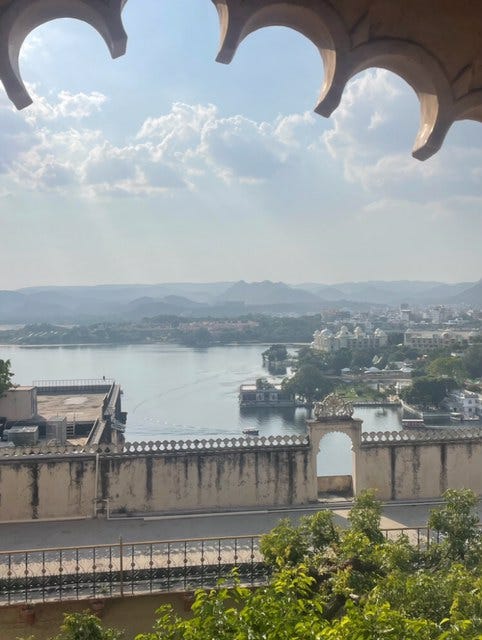
Our Conversation Highlights
I (Neha) am a first year student and Mehr is in her third year, she is at a point now where she needs to figure out a narrow path in life, choose a career, and make decisions about her career, life after university, projects, etc. In our syncs, we often find this particular first year vs third year perspective very interesting. This also makes us think a lot about decision making in a spicy tableau of enthusiastic, rose tinted world full of possibilities first year perspective vs a more practical and selected possibilities third year perspective. After having our first sync, it made me think that I should take more chances while I can, and explore more when there are no real stakes involved so that when the time comes for me, I could be confident in my big decisions for life.
Topics that we touched upon in the first 2 weeks:
Making decisions → exercising judgment
Tunnel vision
External validation vs. internal validation
We both found ourselves in a state of analysis paralysis when it comes to decision making and exercising judgement not on just big decisions but on small decisions like what to do this summer or what course to take? Then we talked about how this paralysis is not a paralysis of having too much choice but actually it’s just a paralysis of having little faith in yourself that no matter what choice you make; you will be good. That week, I visited a museum curator in Sonepat, a very small village in the middle of nowhere as part of a research-based course. The curator curates the entire museum for the village with his own savings and also works as a journalist for local newspapers. He was sitting there by the side of the workers who were doing restoration work for the museum when we entered ( It was like a literal scene transported from Anita Desai’s The Museum of final journeys).
Observing him talk with passion as well as realizing the patience it must have taken to dedicate his life to this, I wondered where he gets this internal validation system to not make a fuss about his work, to show up every day without external rewards of fame, money or validation tied to his effort.
This same feeling came back to me while I was reading Primo Levi’s writings and specifically how he was describing the character Enrico.
We were sixteen, and I was fascinated with Enrico. He was not very active, and his scholastic output was pretty meager, but he had virtues that distinguished him from all the other members of the class, and he did things that nobody else did. He possessed a calm, stubborn courage, a precocious capacity to sense his own future and to give it weight and shape. He turned his back (but without contempt) on our interminable discussions, now Platonic, now Darwinian, later still Bergsonian; he was not vulgar, he did not boast of his virile attributes or his skill at sports, he never lied. He knew his limitations, but we never heard him say (as we all told each other, with the idea of currying comfort, or blowing off steam): "You know, I really think I'm an idiot." He had a slow, foot-slogging imagination: he lived on dreams like all of us, but his dreams were sensible; they were obtuse, possible, contiguous to reality, not romantic, not cosmic. He did not experience my tormented oscillation between the heaven (of a scholastic or sports success, a new friendship, a rudimentary and fleeting love) and the hell (of a failing grade, a remorse, a brutal revelation of an inferiority which each time seemed eternal, definitive). His goals were always attainable. He dreamed of promotion and studied with patience things that did not interest him
We discussed the museum curator and Enrico and we felt our heart swell for a internal validation system as strong as them. What does it take to build a life so uniquely yours? What does it take to fill up your own space in your life completely?…To make your life yours and not someone else’s.
We agreed that the brain demands for evidence. Building trust with yourself is a step-by-step process of gathering evidence. This leads to building a really strong foundational internal validation system that would guide your life’s work. We also discussed about how this process of going from zero to one of building trust with yourself and your choices includes facing your weak points or lack of skills objectively.
Somewhere I read, in Silicon Valley, when somebody gets hold of a lot of money, they are either kind, curious or a jerk. When society gets you a get-out-of-here free card, you tend to behave how you are most comfortable with. It helps you bucket-sort on what kind of people are additive to your gameplay.
This made me wonder, how would I behave in the face of abundance? We both discussed how it’s easier to desire ambition or achievement in situations of scarcity but if you desire ambition even in conditions of abundance it reveals your nature as opposed to your desire for the sake of external validation. (This is tricky here because nature can be a result of desire as well but that discussion apart)
Here we unlocked a powerful mindset shift or mental model to start programming our brains for internal validation system.
After sharing experiences we realized how our insecurities/ shortcomings do get amplified in the face of abundance. Pursuing things just for the sake of external validation, to get out of one/many shortcomings or to feel good about ourselves or just doing them because that’s what everyone else is doing around us is not gonna make our limitations disappear like that, it will amplify as we will be faced with more pressure and responsibility immediately.
So we noticed that we can think about the mental framework discussed above to think about our behaviour in the face of abundance and stop to look around and fix things before insecurities get revealed in mortifying ways when actual abundance arrives.
The Rabbit Hole